Italian American Heritage Project
The Italian American Heritage Project (IAHP) provides educational resources about Italian American history, heritage,
and culture with a straightforward view on the roles of Italians in American history and culture.

IMMIGRATION
INTERNMENT
STEREOTYPES
All rights reserved. No part of this publication may be reproduced without permission except when published with this credit:
Excerpt from the Italian American Heritage Project, ©2018-2026 Janice Therese Mancuso.
Copyright 2018-2026 Janice Therese Mancuso
Contact: jtmancuso@earthlink.net Subject: IAHP


The Columbus Letter
On his return to Spain after his first voyage west, Christopher Columbus wrote three letters describing his exploration of
the islands. According to numerous sources, one letter was for the Monarchs of the Spanish Court, Queen Isabella and
King Ferdinand; one was addressed to Luis De Sant Angel (Santangel), who helped finance the voyage; and one to
Gabriel Sanchez, treasurer of the Monarchs.
Copies of the letters were made by hand and sent to printers throughout Europe, where the letters were translated into
different languages, copied (again by hand), type-set, printed, and distributed. Passages in the various versions of the
letters are worded differently, and although the passages essentially convey similar messages, they can be interpreted to
have other meanings.
For many years, students have been taught about Columbus through fragments of phrases taken from the letters. These
small sections of words have been used against Columbus to portray him as solely responsible for the mistreatment of
the natives on the islands.
The lesson plans provide learners with a well-rounded approach in determining what Columbus wrote. Students examine
passages from the letters to learn what was reported through the translated editions. In grades 1 to 4, children learn about
Columbus’s account of the people on the islands and how they lived. In grades 5 to 8, children learn about native culture
and some of the reasons why Columbus made the expedition. High school students analyze the three letters for
similarities and differences.
Lesson plans for all grade levels include numerous opportunities for involvement with age-appropriate activities and
varied topics for class discussions. All include PowerPoint presentations for ease in creating a positive and informative
class experience.
The lesson plans – as a Word document with teacher instructions and the accompanying PowerPoint presentation – are
available for download at sharemylesson.com. (No fees to pay, but registration is required.)
What Did Columbus Say?
Grades 1-2 Lesson Plan
Grades 3-4 Lesson Plan
Grades 5-8 Lesson Plan
Decoding the Columbus Letter
Grades 9-12 Lesson Plan
An Italian discovered America; another Italian gave her his name; still another Italian first planted
the English flag on American soil and gave England her claim to North America and the American
people their first claim to independence; other Italians explored, or helped to explore, her coasts,
from the Atlantic and the Gulf of Mexico to the Pacific, as well as her interior, from Florida to
Mississippi, from Arizona to Kansas, from Minnesota to Louisiana.
~ Giovanni Schiavo, Four Centuries of Italian-American History
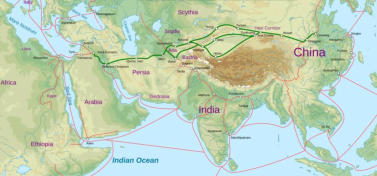
Spanning
from
the
thirteenth
to
the
nineteenth
century,
Italian
explorers
traveled
throughout
the
world,
from
trekking
through
snow-covered
pathways
in
the
East
–
with
a
message
from
the
pope
to
the
Great
Khan
–
to
documenting
the
flora
along
the Pacific Coast of the Americas for the King of Spain.
Part
One
highlights
the
travels
of
the
Polo
family.
Marco
Polo
was
just
17
when
he
traveled
to
China
with
his
father
and
uncle.
His
book
about
his
travels
is
world-known,
even
though
a
Franciscan
friar journeyed to China and wrote about his travels 50 years earlier.
NOW AVAILABLE
Italian Explorers - Part One
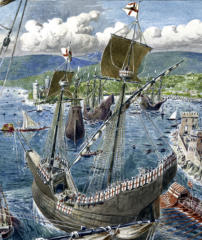
Seeking
a
quicker
route
to
the
East,
in
1291
brothers
Vandino
and
Ugolino
Vivaldi
–
trade
merchants
and
navigators
in
Genoa
–
manned
two
galleys
and
sailed
south.
The
first
known
Europeans
to
sail
through
the
Strait
of
Gibralta
did not return.
Historians
provide
several
theories
about
their
disappearance.
Learn
about
the theories in Part One of Italian Explorers.
A
PowerPoint
presentation
and
lesson
plan
(Word
document)
are
available
for
download at
sharemylesson.com
. (
No fees to pay, but registration is required.)